
A roundup of five new Independent Center Voice & Independent Leadership Council benchmark surveys finds a consistent pattern nationwide: low approval for Congress, deep concern about the health of democracy, and strong favorability for bipartisan and independent candidates.
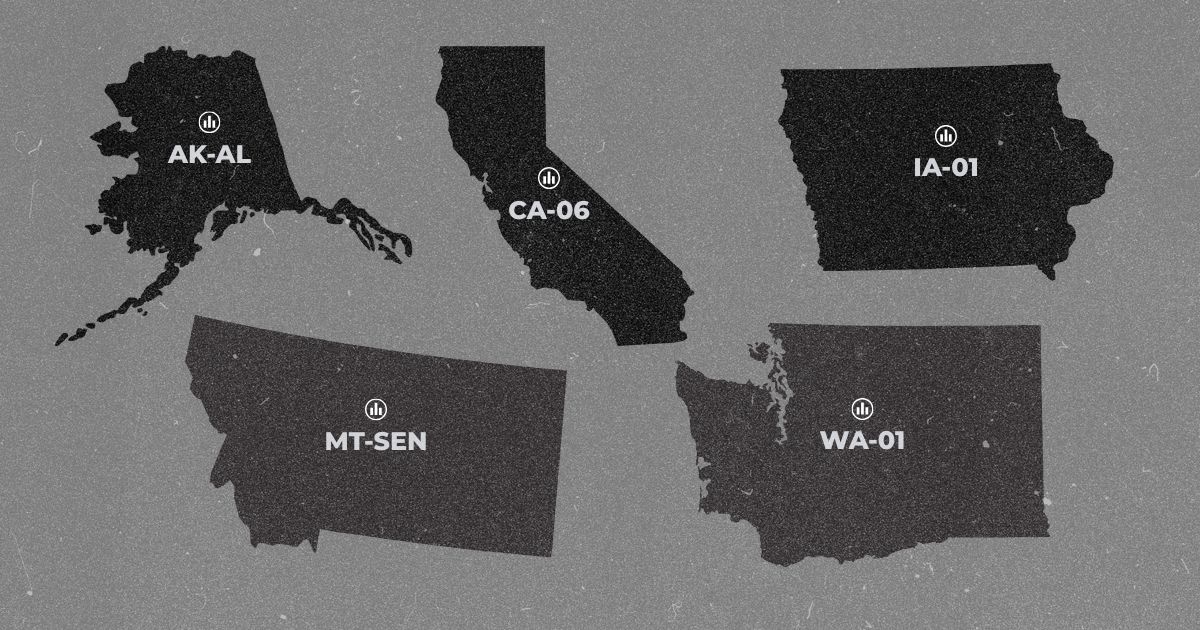
New Independent Center Voice & Independent Leadership Council surveys across Alaska, California, Iowa, Montana, and Washington point to the same underlying story: voters are frustrated with both parties and open to candidates who put country over caucus.
Independent Center Voice, in conjunction with Independent Leadership Council, fielded five new benchmark surveys this month, covering an at-large House seat in Alaska, competitive House districts in California, Iowa, and Washington, and an open U.S. Senate race in Montana. Each survey was conducted independently, in different states with different candidates and different partisan lean. Yet across all five, the same story kept surfacing: voters are unhappy with Washington, skeptical of both parties, and unusually receptive to candidates who reject straight-ticket politics.
Congressional job approval never topped 23% in any of the five surveys, and disapproval ran as high as 78% in Washington's 1st District. Across all five races, roughly nine in ten voters said federally elected officials in Washington "could be doing better," a remarkably uniform result given how different these electorates are on paper.
Majorities of 74% or higher in every single survey described the current health of American democracy as unhealthy, ranging from 74% in Montana to 81% in Washington's 1st District. That concern held regardless of a state's or district's underlying partisan makeup.
In every survey, a hypothetical politician described as "willing to work with both sides of the aisle" earned favorability at or above 80%, well ahead of either major party's own favorability rating in that same electorate. A generic "politically independent candidate" also outperformed both major parties' brand favorability in all five surveys, even in states where actual independent candidates on the ballot remain far less known by name.
Self-identified independents ranged from 29% of the electorate in California's 6th District and Montana to a striking 61% in Alaska, where the state's ranked-choice system gives that bloc outsized influence over the final outcome. In four of the five races, a majority of voters said they'd prefer a representative who doesn't caucus with either major party.
Independents make up 61% of the electorate here, the largest share of any race surveyed, and ranked-choice voting means their second-choice picks could ultimately decide the winner among Republican Nick Begich, Democrat Matt Schultz, and independent Bill Hill.
Independent Kevin Kiley trails Democrat Richard Pan by just four points, with more than a quarter of voters still undecided and strong intensity among Kiley's current supporters.
Independent Michael Bridgford trails a competitive Bohanna-Miller-Meeks contest, but the bigger factor may be name recognition: 53% of voters say they've never heard of him, even as a majority favor non-caucusing representation in the abstract.
Republican Kurt Alme leads a three-way Senate field, but independent Seth Bodnar narrowly edges out Democrat Alani Bankhead for second place, with 17% of voters still undecided.
Ahead of the August 4 primary, Democrat Susan DelBene holds a clear favorability edge, while independent James Etzkorn remains the least known candidate in the field, even as district voters rate bipartisan appeal unusually highly.
Taken together, these five surveys suggest the appetite for independent and cross-partisan representation isn't confined to any one state or type of district; it shows up in deep-red Montana, deep-blue Washington, and everywhere in between. Whether that appetite translates into votes will depend heavily on whether independent candidates can close the name-recognition gap that separates abstract support for independents from support for the specific independent on the ballot. Independent Center Voice will continue tracking all five races as primaries conclude and the general election field comes into focus.