
Latest polling reveals voters want practical solutions, not partisan gridlock
When asked what issues concern them most, American voters speak clearly—and their priorities don’t fit neatly into partisan boxes. A new nationwide poll of 1,000 registered voters shows that practical, bread-and-butter issues dominate the political agenda. The data reveals a critical insight: voters are ready for candidates willing to take the best solutions from across the political spectrum, and they’re remarkably willing to compromise.
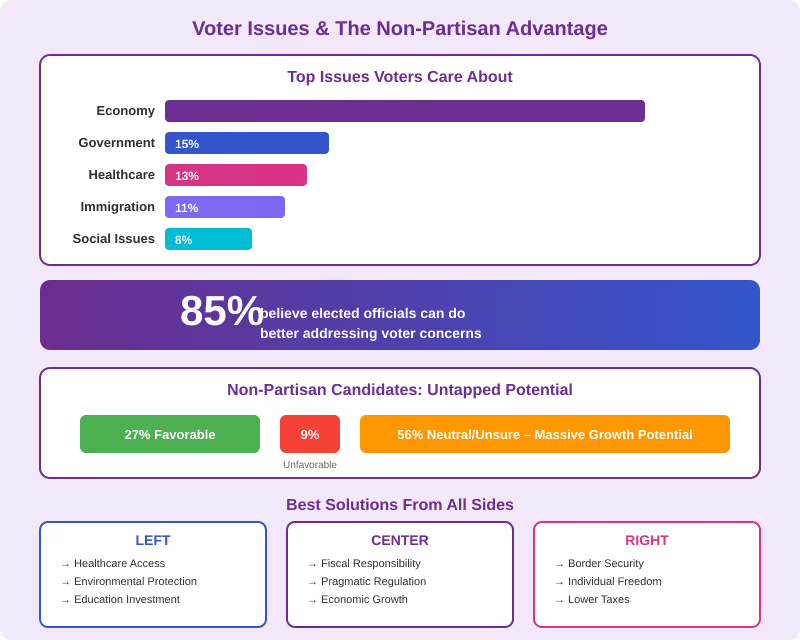
When voters rank the issues they care about, the economy dominates the conversation. 44% of registered voters cite the economy as the most pressing issue facing the country—with inflation and food prices accounting for 65% of economic concerns and job availability at 17%. Beyond the economy, voters care about practical governance and policy challenges: Government Issues (15%), Healthcare (13%), Immigration (11%), and Social Issues (8%).
When asked what issues should be prioritized for solutions, the picture shifts slightly, with healthcare (27%), immigration (17%), taxes (11%), and Social Security (12%) rising in importance. This pattern reveals something crucial: voters understand that different issues require different levels of attention depending on the political landscape.
The polling data reveals why non-partisan candidates are uniquely positioned to address voter concerns. Unlike party-bound candidates, independents can draw solutions from across the political spectrum without ideological constraints. This “best from all sides” approach resonates with voters. 30% of Americans identify as moderate or centrist—the largest single group on the political philosophy scale—and 34% hold an overall moderate ideology. These voters aren’t extreme; they’re pragmatic.
Critically, 39% of registered voters say they will support candidates who prioritize bipartisan cooperation, signaling clear demand for problem-solving over partisanship. And when asked to evaluate the “Representation” argument—that most Americans don’t fit into “Red” or “Blue” boxes—12% identified it as the most compelling case for non-partisan candidates.
Perhaps most telling: voters demonstrate willingness to compromise across multiple issues. When asked which issues they’d be willing to compromise on, voters showed flexibility on taxes (13%), environment (12%), immigration (12%), and healthcare (9%)—proving the appetite for pragmatic, middle-ground solutions exists. That said, 26% say they are unwilling to compromise on any issue, suggesting a vocal minority of ideological purists. But the clear majority—74%—demonstrates openness to nuanced solutions that don’t fit partisan talking points.
The bottom line is this: voters want elected officials who will do their jobs better (85%), are willing to compromise on most issues (74%), and represent the complex reality of modern America rather than extreme ideological positions. A non-partisan candidate, unburdened by party loyalty, is best positioned to deliver exactly that.
The polling reveals a massive opportunity. While only 27% currently view non-partisan candidates favorably, 56% remain neutral or unsure. This isn’t rejection—it’s untapped potential. As voters learn about candidates willing to take pragmatic solutions from left, center, and right, these numbers could shift dramatically.
The 2026 election offers a chance to build a new political movement centered not on ideology, but on solving the problems voters actually care about: a strong economy with controlled inflation, accessible and affordable healthcare, secure borders, and a functioning government that rises above partisan gridlock.
The data is clear. America is ready for non-partisan solutions.
Independent Center Voice 2026 Nationwide Online Survey of 1,200 adults including 1,000 registered voters. Field dates: December 30, 2025 – January 1, 2026. Total adult margin of error: ±2.83%. Registered voter margin of error: ±3.1%.