
As America approaches its 250th, voters declare the status quo "broken" and demand new options
January 2, 2026
As the sun rises on 2026, America stands at the threshold of a historic milestone: our 250th anniversary. But according to the first major political poll of the year, conducted by the Independent Center Voice alongside in-depth focus groups, the mood of the electorate is not one of celebration, but of deep concern.
The data reveals a nation at a crossroads. While Americans cherish their history, they are profoundly anxious about their future. A staggering 64% of voters rate the current health of American democracy as "unhealthy", and nearly half (48%) are not confident our system of government will endure for another 250 years.
Yet, amidst this dissatisfaction, a clear signal is emerging from the noise: independent-minded voters are finished with the gridlock. They are tired of the "lesser of two evils," and they are ready to rebuild.
The first takeaway from our 2026 tracking poll is the stark contrast between the electorate’s desire for solutions and their disdain for current leadership. The partisan stalwarts dominating our headlines are failing to connect with the average American.
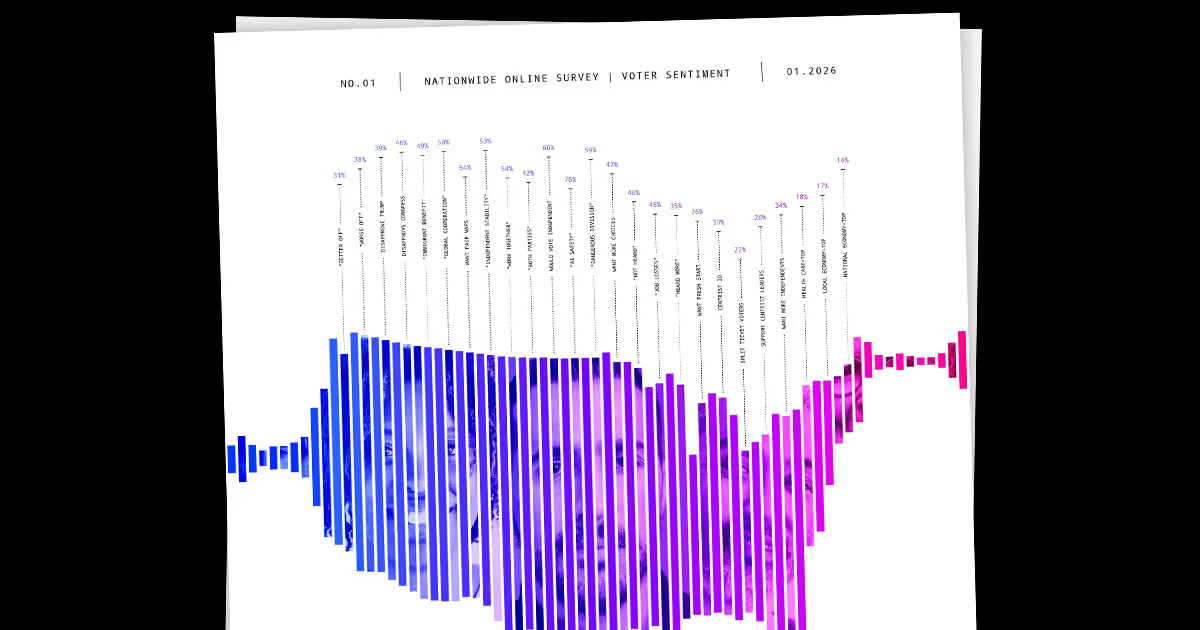
President Donald Trump starts the year with a 58% disapproval rating , while Congress fares even worse, with 61% disapproving of the job they are doing. When we look at favorability, the brand toxicity of the major parties is undeniable. Only 31% of voters view the Republican Party favorably, and the Democratic Party sits at just 35%.
However, there is a beacon of hope in the data. While voters reject partisanship, they are craving cooperation. A hypothetical "politician willing to work with both sides of the aisle" holds a massive 63% favorability rating—nearly double that of the President or the GOP.
Our focus group participants echoed this sentiment, describing a political class that has lost its way. As Adam, a participant from Michigan, put it: "The corruption in our government just shows how it's not about the people anymore. It's about them making money in any way possible".
When asked to look toward the next 250 years, voters did not mince words. They view our current political system not just as flawed, but as a "broken tool" incapable of fixing modern problems like the economy, AI, or climate change.
The top issue for voters remains the Economy (46%), specifically the crushing weight of inflation and food prices. In our qualitative sessions, younger voters expressed a profound sense of economic betrayal. Krystal from Erie, PA, noted, "The poor get poorer... Prices of cost of living is absolutely insane now".
This economic anxiety is compounded by a belief that the two-party system is structurally incapable of delivering relief. The prevailing view is that the system is rigged by special interests. Ian from Washington described the current state of campaign finance as "legalized bribery," noting that "very few laws actually benefit us, the average Joe".
Voters are calling for systemic reforms to guide us into the next century. They want a government that prioritizes long-term stability over short-term partisan wins. As it stands, 82% of voters believe Washington can do better at addressing the issues that concern them most.
Perhaps the most explosive finding in our 2026 data is the sheer appetite for ballot access reform and independent candidates. The narrative that Americans are strictly divided into "Red" and "Blue" camps is a myth.
When asked if expanding options to include more than just the two major parties would better serve democracy, 56% of voters agreed, compared to only 24% who want to stick with the status quo.
Even more striking is the potential viability of an alternative. When presented with a scenario of a "strong, well-funded independent candidate" who is willing to work with both sides, 76% of voters said they would be likely to vote for them.
Why the shift? Voters are not looking for a spoiler; they are looking for a problem solver. The top reasons cited for supporting an independent were the "People over Party" argument (27%)—the idea that a representative should answer to constituents, not a party boss—and the "Problem Solver" argument (27%).
As Broden from Harrisburg told us in our focus groups: "It just forces you to pick the lesser of two evils. And I just wanna pick someone that's more in line with my needs... neither Democrat or the Republican".
The data from the start of 2026 sends a warning to the political establishment: You are losing the people. The electorate is exhausted by division, suspicious of corruption, and desperate for a new way forward.
As we approach America’s 250th anniversary of the signing of the Declaration of Independence, the greatest gift we can offer the republic is a political system that actually works. The voters are ready for more voices, more choices, and leaders who prioritize the country over the party.
About the Data: This poll was conducted online from December 30, 2025, to January 1, 2026, among n=1200 Adults (n=1000 Registered Voters). The margin of error for registered voters is ± 3.1%. Qualitative insights were derived from two focus groups conducted between 29-31 Dec 2025.