
A majority of Americans believe the two-party system is limiting democracy. Our January 2026 nationwide poll reveals that voters are hungry for alternatives—and independent candidates are uniquely positioned to deliver them.

Democracy thrives on competition and choice. Yet for decades, America’s political system has been dominated by a duopoly that leaves millions of voters feeling unrepresented. New data from the Independent Center Voice’s nationwide survey paints a clear picture: voters are ready for change, and they recognize that independent candidates offer a path forward.
The evidence is compelling. A commanding 57% of registered voters say that “expanding our options to include more than just the two major political parties” would better serve democracy. In stark contrast, only 25% prefer sticking with the current two-party system. This isn’t a close call—it’s a decisive mandate for expanding democratic choice.
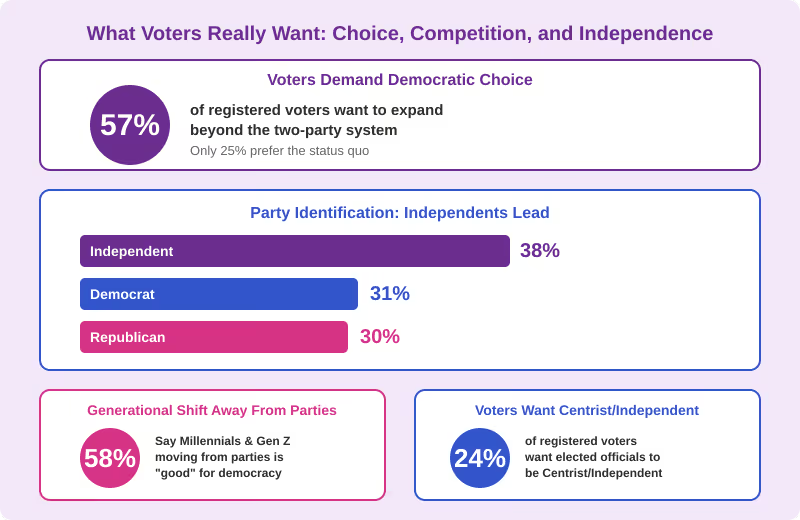
Perhaps most striking is the sheer number of Americans now identifying as independent. Our poll finds that 38% of registered voters identify as Independent—making it the largest single political affiliation in the country. This is larger than the Democrat (31%) or Republican (30%) parties. The era of party dominance is giving way to an age of independence.
This shift is especially pronounced among younger Americans. A strong 58% of registered voters say the shift of Millennials and Gen Z away from party labels is a “good thing” for democracy. Only 21% view this trend negatively. Younger voters are voting with their values, not with their party registration, and the electorate is following suit.
Voters show growing openness to independent candidates. When asked about a “politically Independent candidate,” 38% view such candidates favorably, with only 8–9% unfavorable. For “an elected official that is not a member of either party,” 31% view them favorably versus just 10% unfavorable.
When it comes to actual voting behavior, 11% of registered voters say they would vote “Other/third-party/Independent” in the 2026 midterms. Additionally, 27% of registered voters will use their vote to support independent or non-partisan candidates who promise to modernize government and be accountable to people rather than parties. This represents a significant and growing voting bloc. In a three way race this adds up to more than enough to win a pluralistic majority.
The message is clear: voters want choices. They want representatives who answer to their constituents, not party bosses. They want politicians who will compete for their vote by addressing their real concerns, not parsing party doctrine. Independent candidates, unburdened by party machinery, are uniquely positioned to deliver this vision.
The data is unambiguous. A decisive majority of Americans believe the two-party system is limiting democracy. Nearly two-fifths of the country identifies as independent. Younger voters are explicitly rejecting party labels. And millions are ready to cast ballots for independent and third-party candidates in 2026.
The window of opportunity for independent candidates has never been wider. The question is not whether voters want more choices—they clearly do. The question is whether independent candidates and political movements will rise to meet this historic moment and give Americans the representative democracy they are demanding.
Independent Center Voice 2026 Nationwide Online Survey of 1,200 adults including 1,000 registered voters. Field dates: December 30, 2025 – January 1, 2026. Total adult margin of error: ±2.83%. Registered voter margin of error: ±3.1%.