
January 2026 Nationwide Poll Reveals Voters’ Desire for Capable Leaders Who Work Across Partisan Divides

Across the American political landscape, a clear consensus is emerging: voters crave capable problem-solvers who can transcend partisan gridlock. According to the Independent Center Voice’s comprehensive January 2026 nationwide poll of 1,200 adults and 1,000 registered voters, the electorate’s priorities have shifted decidedly toward candidate quality, pragmatism, and cross-aisle cooperation.
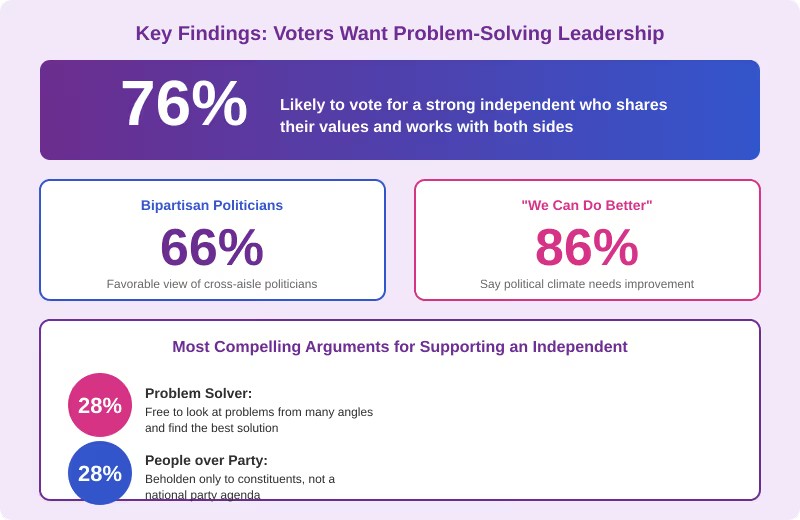
The data presents a compelling narrative about what American voters truly value in their elected representatives. With 86% of registered voters saying “we can do better” about the current political climate, and 64% rating American democracy as unhealthy, there is an unmistakable call for change. This dissatisfaction extends directly to performance: 85% say elected officials in Washington can do better at their jobs, and 84% believe they can do better at addressing voters’ primary concerns.
Perhaps most striking is voters’ explicit preference for candidates willing to work with both sides of the aisle. Fully 66% of registered voters hold a favorable view of such bipartisan-minded politicians, while only 7% view them unfavorably. This represents a fundamental shift in voter sentiment—a rejection of the zero-sum, partisan mentality that has dominated politics for decades.
When presented with the prospect of supporting a strong, well-funded independent candidate who shares their values and works with both sides, 76% of registered voters indicated they would likely vote for such a candidate, compared to just 10% unlikely. This speaks volumes about voter appetite for alternatives to traditional party politics.
The message voters send through their stated priorities is unambiguous: they value results over ideology. When asked what factors would motivate them to look past party labels, 39% of registered voters cited candidates who prioritize bipartisan cooperation and seek to modernize the system. Additionally, 34% would vote based on individual character and honesty, regardless of party affiliation.
The two most compelling arguments for supporting an independent candidate are tied at 28% each. The first centers on problem-solving: “Independent-minded leaders are free to look at problems from many angles and find the best solution, rather than being forced to view every issue through a single partisan lens.” The second emphasizes independence from party interests: “Political parties have become too focused on special interests and self-preservation; an Independent is beholden only to their constituents, not a national party agenda.”
These findings reflect a fundamental truth about modern American politics: voters are not ideologically broken. Rather, they have grown exhausted by leaders who prioritize party loyalty over constituent welfare, who would rather score political points than solve real problems. The electorate is signaling that it’s ready to support candidates—whether independent or traditionally affiliated—who can demonstrate genuine commitment to cross-party collaboration and pragmatic problem-solving.
As 2026 unfolds, these data points should serve as a wake-up call to all political actors. The voters have spoken: they want capable, honest leaders committed to finding common ground. Candidate quality and a genuine commitment to problem-solving are no longer luxuries in American politics—they are what voters demand. Those who can deliver on this promise will find themselves well-positioned for success.
Independent Center Voice 2026 Nationwide Online Survey of 1,200 adults including 1,000 registered voters. Field dates: December 30, 2025 – January 1, 2026. Total adult margin of error: ±2.83%. Registered voter margin of error: ±3.1%.